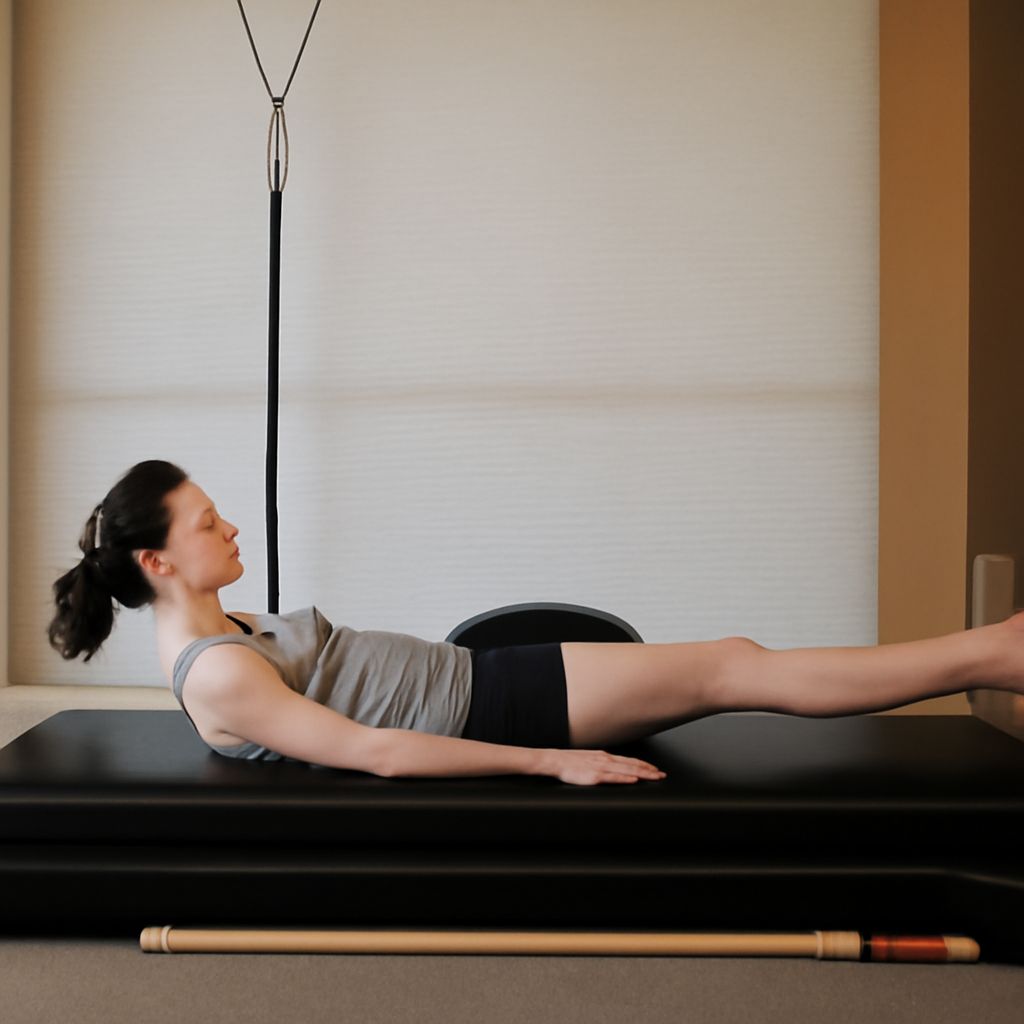
The pilates 100 has the reputation of being a warm-up exercise. For beginners, it is genuinely challenging enough to be a standalone workout. The movement requires sustained core engagement, coordinated breathing, and shoulder stabilization all at once. People who assume the pilates hundred is easy have usually never done it correctly.
The pilates pro distinction often comes down to the 100. Advanced practitioners complete it with straight legs lowered close to the floor, full spinal flexion without tension in the neck, and a precise five-inhale, five-exhale pump cadence. Beginners work with bent knees and the legs at table-top. Both versions are the same exercise at different levels of difficulty, and the progression between them takes genuine work.
Breaking Down the Pilates Hundred Exercise
Start lying on your back. Draw the knees to table-top or extend the legs to 45 degrees depending on your level. Lift the head and shoulders off the mat in a gentle spinal curl, reaching both arms long alongside the hips. Begin pumping the arms in small, controlled up-and-down pulses, about six inches of range.
Breathe in for five pumps, out for five pumps. That’s one cycle of ten. Repeat ten times to reach 100 total pumps, which is where the exercise gets its name. Keep the lower back pressed into the mat throughout. If it arches, raise the legs higher or bend the knees more until you can maintain the connection.
Neck strain is the most common issue for beginners. The head should be heavy in spinal flexion, not straining forward. If you feel tension building in the neck after 20 or 30 pumps, lower the head to the mat, rest briefly, and resume. Building cervical flexor endurance takes several weeks of consistent practice.
A pilates blog or class focused on the hundred will often include variations that progress the challenge. Adding a slight rotation each pump cycle, alternating the arms, or performing the exercise on a Reformer with foot straps adds complexity. None of these are necessary until the basic version is controlled and comfortable for the full 100 counts.
The 100 lb kettlebell is sometimes referenced in comparison to Pilates work as a shorthand for heavy strength training at the opposite end of the intensity spectrum from controlled Pilates movements. The point is that each system produces different adaptations. Pilates hundred training builds the specific neuromuscular coordination and deep stabilizer endurance that no amount of kettlebell work replaces.
Safety recap: if you have a herniated disc or acute neck injury, consult a physical therapist before attempting the Pilates hundred. The sustained spinal flexion loads the cervical and lumbar regions in ways that may be contraindicated for certain conditions. Modified versions with the head down are available for practitioners who cannot safely flex the spine.