How can you practice turning your thigh outward without forcing your knee or rolling your pelvis? Start in a supported position, move through a small comfortable range, and return slowly. Exercises for external hip rotation are easier to control when the rest of your body has a stable base.
These movements for rotating the hip use a chair or floor for support. They can help you notice where the motion comes from and gradually practice it with control, rather than chasing a particular angle.
Hip rotation exercises: What outward rotation means
The hip is a ball-and-socket joint. External rotation occurs when the thighbone turns outward in the socket. With your knee bent, one visible example is a side-lying position in which the top knee opens upward while the feet remain together. The movement should come from the hip; rolling the pelvis backward can make the knee appear to travel farther without adding the same rotation.
Hip external rotation exercises can involve movement, a brief hold or gentle resistance. The examples below use little or no equipment and emphasize a stable pelvis. Begin with a few easy minutes of walking around the room, then choose a position you can enter and leave comfortably. Use a firm chair that will not slide and a mat or folded blanket if lying on the floor.
1. Seated rotation with a supported thigh
Sit near the middle of a stable chair with your back upright, feet on the floor and knees comfortably apart. Rest your hands on the chair or your thighs. Keep one thigh supported on the seat and its knee pointing forward. Lift that foot just enough to clear the floor, then move it a little inward toward the other foot. With the knee bent, the lower leg moving inward accompanies outward rotation at the hip.
Return the foot slowly to its starting position. Try 6 to 8 repetitions on each side, moving only as far as you can without leaning, shifting your pelvis or twisting the knee. If lifting the foot is difficult, use a higher seat or reduce the movement to a very small arc. Keep the other foot planted for balance.
2. Side-lying clamshell
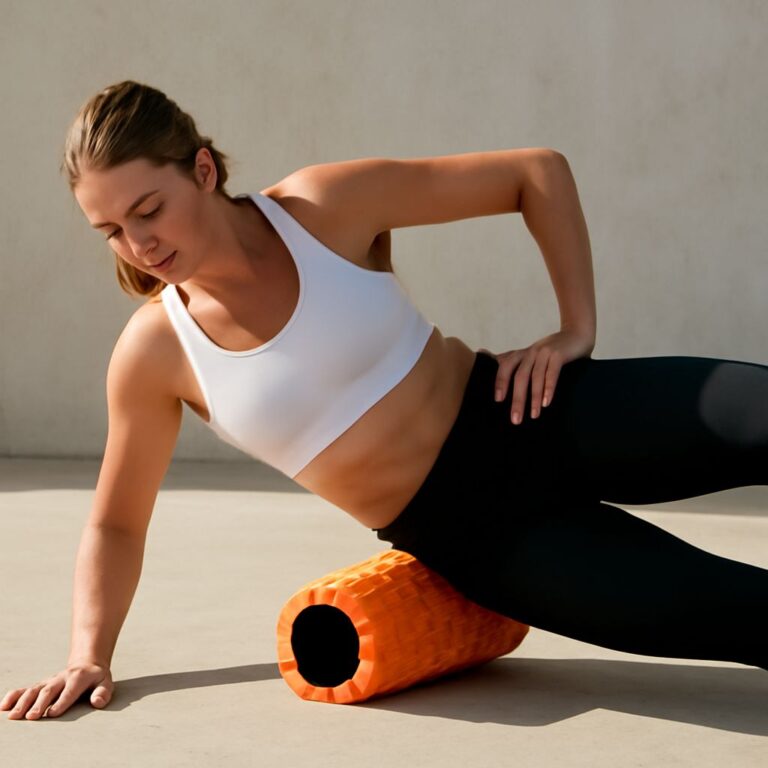
Lie on your side with your head supported by your lower arm or a pillow. Bend your hips and knees comfortably, stacking your shoulders, hips, knees and feet. Keep your feet together and slowly lift the top knee a small distance, then lower it with control. Try 8 to 10 repetitions before turning over and repeating on the other side.
Place a hand on your upper hip to feel whether it rolls backward. The opening may be modest; stop where you can hold the pelvis steady. If you feel strain at the knee, check that your legs are supported and reduce the range. The American Academy of Orthopaedic Surgeons describes the same basic clamshell action with the feet together and pelvis still.
Once the unweighted movement feels consistent, a light loop band above the knees can add resistance. Use a band you can control and avoid pulling the knee farther open just to stretch it. If the band makes you roll backward or hold your breath, remove it and return to the unweighted version.
3. Supine knee opening
Lie on your back with your knees bent and feet flat, about hip-width apart. Rest your arms beside you. Keeping one foot on the floor, allow that knee to move outward a short distance while the other leg remains comfortable and still. Bring the knee back to the starting position slowly. Perform 6 to 8 repetitions on each side.
The floor supports your trunk and gives you a reference for keeping both sides of the pelvis settled. Keep the movement small enough that the opposite hip does not lift or roll toward the moving leg. You can place a folded towel beside the moving knee as a reminder of your chosen range; do not force the knee down onto it.
Choose a manageable amount
These external hip rotation exercises can be practiced one at a time. Start with one set of the suggested repetitions and rest as needed. A smooth return is part of each repetition, so move slowly enough to control it in both directions. The two sides may have different comfortable ranges; let each side use its own.
Reduce the range or stop if you notice pinching, sharp pain, a knee strain or a need to hold your breath. If symptoms persist, or if you have a recent injury, surgery or specific movement restrictions, ask a qualified clinician which movements are appropriate before continuing. These drills are for general movement practice, not a treatment plan.
As you practice rotating the hips outward, watch for the most common compensation: the pelvis rolls or shifts while the thigh moves. Place a hand on your hip, shorten the movement until the pelvis stays settled, and repeat at that smaller range.