The misconception that using a wall in yoga practice is a crutch for inflexible beginners misses one of the most useful tools available to practitioners at every level. Wall yoga uses a vertical surface as a prop to provide feedback, reduce load, increase range of motion, or support recovery from injury. The category of easy partner yoga poses often borrows from wall-assisted principles — the partner provides the same resistance and feedback that a wall delivers, making the two approaches complementary rather than separate. Specific wall yoga poses allow practitioners to safely access inversions, deep hip stretches, and spine decompression that would be inaccessible or unsafe without support. Practitioners managing knee sensitivities benefit enormously from targeted yoga poses for knee pain performed with wall assistance, since the wall reduces the balance demands that force vulnerable joints to compensate. A yoga wall — a rope wall or peg wall system found in some Iyengar and rehabilitation studios — extends these principles into a comprehensive therapeutic and teaching tool.
Adding wall practice to a regular yoga routine is one of the highest-value changes available to practitioners at any experience level. Here is how to integrate it effectively.
Wall Yoga Poses for Flexibility, Alignment, and Recovery
Supported Inversions and Hamstring Deepening
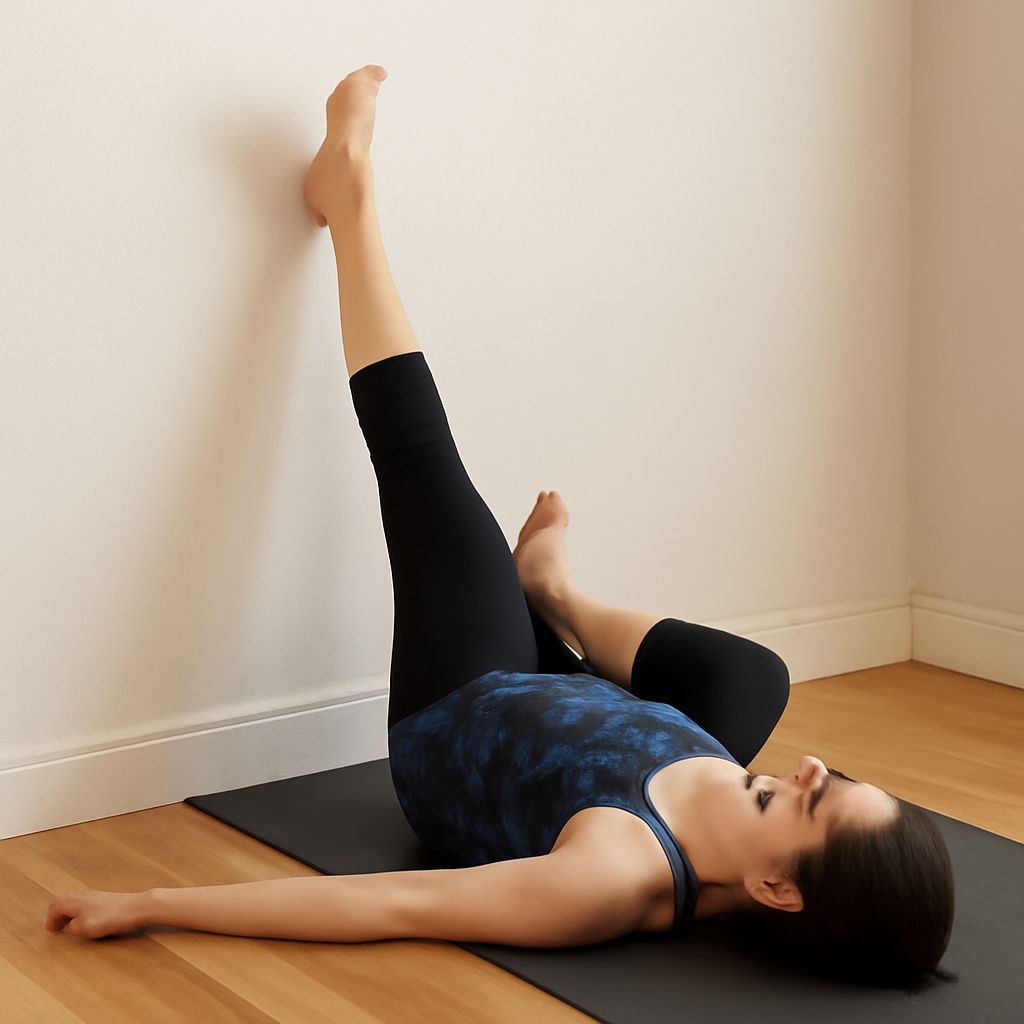
Legs-up-the-wall pose (Viparita Karani) is perhaps the most widely used therapeutic yoga wall pose. Lying on the back with legs vertical against the wall creates gentle traction in the lumbar spine, reduces lower limb swelling, and activates the parasympathetic nervous system. The pose requires no balance, no strength, and no flexibility. It is accessible to virtually every practitioner and delivers measurable benefit in as little as five minutes. For recovery sessions and high-stress days, it is among the most effective interventions available without equipment.
Standing forward folds performed at the wall provide hamstring feedback that floor-based versions cannot replicate. Pressing the sitting bones against the wall while folding forward isolates the hamstring lengthening from the lumbar rounding that typically compensates when hamstrings are tight. This isolation allows practitioners to find genuine hamstring depth rather than the forward-spinal collapse that mimics it without producing the same tissue adaptation.
Warrior III performed with hands on the wall dramatically reduces the balance demand while preserving the hip and posterior chain strengthening that makes the pose valuable. This modification allows practitioners recovering from ankle or knee injuries to maintain training continuity while the affected joint heals, rather than avoiding all single-leg work entirely.
Wall Practice for Knee Pain and Partner Yoga Adaptations
Yoga for knee pain management depends heavily on load reduction and alignment precision. The wall provides both. Standing Chair pose variation with the back against the wall ensures the spine remains neutral and the knee tracks correctly over the second toe, eliminating the compensatory patterns that aggravate patellofemoral pain. The wall’s feedback is immediate and neutral — it does not judge or motivate, it simply reflects the position of the body honestly.
Supine knee stretching sequences performed with one foot on the wall allow progressive hamstring loading without any compression through the knee joint. This is particularly valuable for practitioners with meniscus sensitivities or post-surgical rehabilitation needs. The wall handles the stability demand so the targeted tissues can receive therapeutic stress without protective bracing that limits the stretch effect.
Partner yoga principles translate directly to wall practice. The resistance a partner provides in a back-to-back twist is replicated by the wall’s surface. The stability a partner offers in a balance pose is replicated by the wall’s immovability. Practitioners who enjoy partner yoga for its contact and feedback can use wall practice to develop the same proprioceptive skills independently, then bring them into partner work with a more refined sense of boundary and position.
Rope wall systems found in therapeutic and Iyengar yoga studios extend vertical support practice into traction-based inversions, deep spinal decompression work, and advanced strength training that ordinary wall practice does not support. If you have access to a studio with a rope wall installation, using it under skilled instruction offers a dimension of practice that most practitioners have never explored.