Muscles Used in Squats: A Full Breakdown of What Gets Worked
The standard explanation of squats as a “leg exercise” dramatically underrepresents what actually happens during a well-executed rep. The muscles used in squats span the entire lower body and extend into the core and upper back in ways that surprise many practitioners. Understanding what muscle groups do squats work changes how you program them — because once you see the full muscular picture, squats look less like a quad exercise and more like a whole-body strength tool. A more precise answer to what muscles are used in squats depends on stance width, depth, bar position, and load distribution. Tracking squats muscles used across different variations lets you select the right type for your specific goals. And questioning squats works what muscles as a beginner or intermediate lifter often leads to the discovery that correcting small form errors produces dramatically different training results.
Getting this right matters more than most people realize early in their training. Here is the complete picture of what happens muscularily during a squat.
Primary and Secondary Movers in the Squat Pattern
Quadriceps, Glutes, and the Deep Hip Stabilizers
The quadriceps are the primary movers during the upward phase of the squat. All four heads of the quad contract concentrically to extend the knee from the bottom position. The vastus medialis — the teardrop-shaped muscle on the inner knee — is often the limiting factor in squat depth and knee tracking quality. Practitioners with a dominant vastus lateralis relative to vastus medialis often see the knee cave inward at the bottom, a compensation pattern that increases injury risk.
The glutes contribute significantly during hip extension — the drive from the bottom of the squat upward. In a deep squat (thighs below parallel), the glute maximus is strongly loaded throughout the movement. Shallower squats reduce glute contribution and shift more demand to the quads. This is why depth matters for posterior chain development, not just flexibility display.
The deep hip external rotators — piriformis, obturator internus, the gemelli — work isometrically to maintain femoral external rotation and prevent knee cave throughout the squat. These muscles are rarely discussed in basic squat instruction but are central to both performance and injury prevention. Weak hip rotators manifest as knees collapsing inward under load.
How Stance, Depth, and Bar Position Change Muscle Emphasis
Wide-stance squats with toes angled outward increase the contribution of the adductors — the inner thigh muscles — and reduce the range of motion required at the ankle. This makes wide-stance squatting more accessible for practitioners with limited dorsiflexion. The trade-off is less full quad activation compared to a narrower, more upright stance.
High-bar back squats keep the bar higher on the trapezius and encourage a more upright torso, emphasizing the quads. Low-bar back squats place the bar lower across the rear deltoids, allowing forward lean that shifts more load to the posterior chain — glutes, hamstrings, and spinal erectors. Neither position is superior; each serves different training goals.
Front squats require the most upright torso of any loaded squat variation. This dramatically increases quad emphasis while reducing lower back loading. The core demand also increases, because the load is positioned anteriorly and the body must resist forward lean against it. The spinal erectors, transverse abdominis, and obliques all work harder in a front squat than in a back squat of the same external load.
The hamstrings function eccentrically during the descent phase, controlling the rate of knee flexion. This eccentric load is one reason squats contribute meaningfully to hamstring development even though the hamstrings are not primary movers in the upward phase. Slow, controlled descents increase this hamstring stimulus significantly.
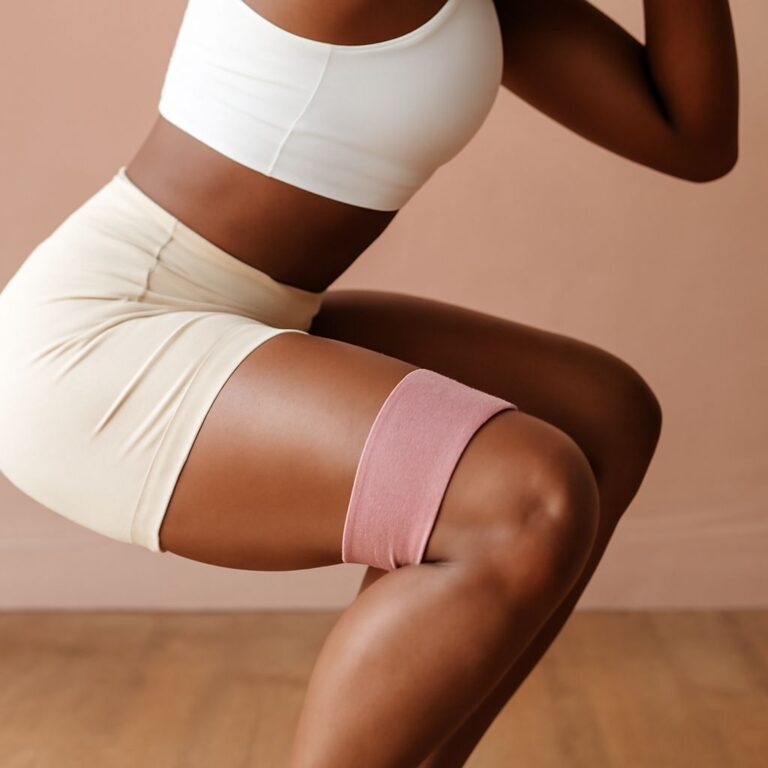
Safety recap: Knee cave during squats indicates weak hip external rotators or abductors — address with banded clamshells and lateral walks before loading the squat further. Rounding of the lower back at the bottom signals core weakness or insufficient hip mobility. Never add weight to a pattern with clear compensation — fix the movement first.